
The Alaska Marine Highway System is undergoing a modernization process as part of its long-range plan. A key initiative in this process is the High Efficiency Commuter Ferry project, which aims to explore both the use of a diesel-electric hybrid propulsion systems for routes that are well-suited for this technology and the expansion of the use of smaller, commuter ferry vessels as a way to lower operating costs and increase service capacity. This project will allow the AMHS and passengers to assess emerging technologies and their potential to increase operational efficiency, while also enhancing transportation infrastructure for coastal communities that depend on affordable and reliable ferry services for economic stability.
Pre-project work began in 2023 when Alaska Department Transportation and Public Facilities (DOT&PF)-AMHS and Southeast Conference (SEC) evaluated the pre-feasibility of hybrid ferries running on fully electric mode across the AMHS service routes. This study identified Ketchikan/Saxman-Metlakatla, Skagway-Haines and Homer-Seldovia as potential hybrid commuter routes in the Low- Emissions Vessel Feasibility Study. Additionally, in 2023, Alaska DOT&PF was awarded approximately $46 million from the Federal Transit Administration for the construction of a new diesel-electric vessel.
With an understanding of potential routes that could support a fully electric operation, SEC and Alaska DOT&PF are proceeding with the analysis of the specifics and realities of operating a smaller hybrid vessel in Alaska. This assessment is broken into three different components: Public Engagement, Shoreside Infrastructure and Vessel Design.
In 2025, Alaska DOT&PF – AMHS hired the naval architect and marine engineering firm Glosten to develop a vessel design and hybrid electric propulsion system that meets run parameters (sea states, climate and length), maximizes vehicle and passenger capacity within the vessel Class-T size for crew efficiencies, and stays within or close to available Federal funds for the vessel construction.
Southeast Conference’s role is to support the Public Engagement needs of Alaska DOT&PF and to evaluate the Shoreside Infrastructure conditions and requirements of the project, including energy availability, charging infrastructure and terminal infrastructure needs. In this role, Southeast Conference implements the Community Engagement Plan, provides grant writing support for dock infrastructure improvements and leads the development of the Vessel Integration Blueprint Plan.
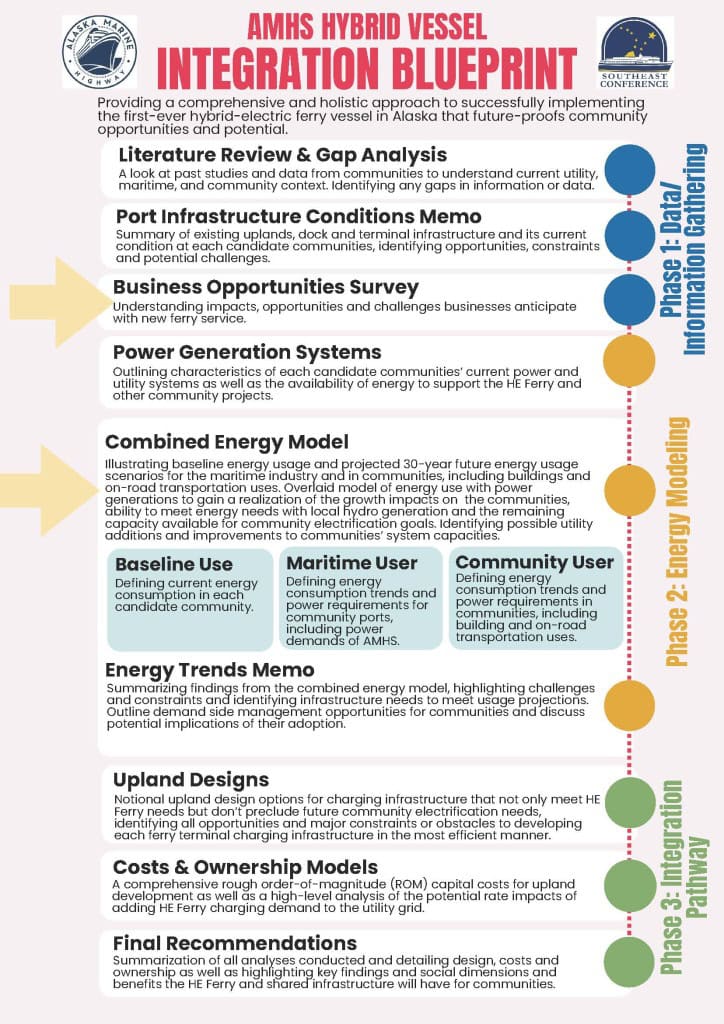
The Integration Blueprint is an extensive research and community evaluation effort to ensure local energy grids can achieve the charging needs of the diesel-electric hybrid vessel while also taking into account community trends and projected community energy needs over the next 30 years. The Integration Blueprint will inform right-sizing shoreside infrastructure for successful vessel integration that supports community goals and opportunities now and into the future.
Visit the project website for more regular updates and upcoming chances for public input.


